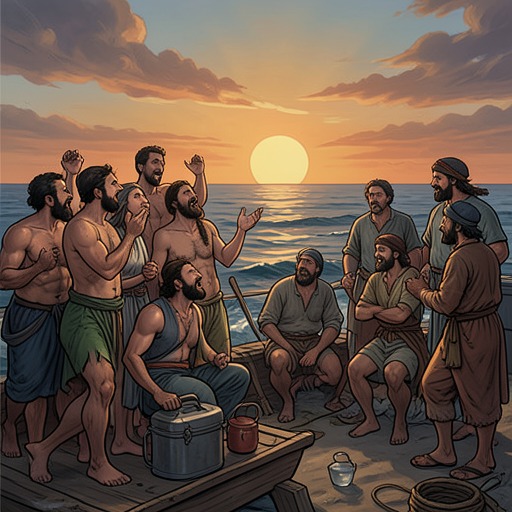
Marie-Josèphe learns to understand the sea woman
The Moon and the SunMarie-Josèphe learns to understand the sea woman through a sustained exchange at the Fountain: the captive’s songs do not translate neatly into words but unfold as images, associations, and remembered experience. Marie-Josèphe first struggles to follow them, then records what she can perceive in rough drawings. The exchange opens a view of the sea woman’s life beyond captivity, including the birth and upbringing of a young sea creature, and makes listening itself a form of attention and witness.
A first exchange
The encounter begins with Marie-Josèphe seated on the Fountain’s rim, imagining a dream in which neither she nor the captive would be imprisoned. The song soon exceeds the boundaries of that thought. As the sea monster sings, Marie-Josèphe sees an image of a male sea monster—the one whose body Yves was dissecting—swimming above her in the tent. The vision persists even when she closes her eyes, making the song’s images appear as vivid to her as the surrounding world.
Marie-Josèphe tests whether the exchange can become conversation. She tells the captive that she sees the songs and asks whether the sea monster understands her, whether she speaks, and whether she uses words. The reply begins with a word-like reference to a fish, then opens into song. The sequence gives Marie-Josèphe a first indication that communication is possible, but not by simply matching one human word to one sea-monster word.
Learning the language of song
The fish-song conveys far more than the animal’s name. It evokes the fish, its surroundings, the sound of its movement, and the taste of its flesh. The sea monsters’ language, as Marie-Josèphe begins to perceive it, works through images and the relationships among them. Its meaning is not a list of separate terms but a connected impression in which an object, its setting, and its qualities belong together.
Marie-Josèphe hums the melody in response. The image she receives is indistinct and fades, a small failure that clarifies how much she still has to learn. She recognizes that her own attempt may reach the sea monster only as a blur and promises to do better. When she asks the captive’s name, the answer comes as a complex melody describing the singer herself and suggesting joy, boldness, and youthful wisdom. Marie-Josèphe responds with delight, but the exchange has not made the language transparent: she can recognize that the song contains a self-portrait without translating it into an ordinary name.
To preserve what she hears, Marie-Josèphe runs to the laboratory for scraps of paper and charcoal. She does not write the songs as words or musical notes; instead, she sketches their images. Her tears sometimes smudge the paper, but, as she listens, the scenes remain clear to her. The sketches thus become a record of an encounter that cannot yet be captured in either human speech or conventional musical notation.
The life revealed in the images
The song first transforms the captive’s immediate surroundings. The sea monster swims alone in a fountain clouded by dirt and algae, with coins and litter below. In the song’s vision, the water becomes sapphire, the refuse gives way to white sand and living shells, and iridescent fish move through the scene, changing color together. This contrast places the captive’s isolation beside an imagined or remembered marine world, making the Fountain’s confinement visible through what the song shows beyond it.
The vision then follows an older, pregnant sea monster through tropical water toward a secluded island and its white beach. She settles on the sand, and the captive joins her there, followed by a male sea monster and another companion. They gather around the mother, tending to her as she gives birth. The scene presents this as a difficult birth, with the other sea monsters supporting the mother; afterward, she holds and nurses the newborn while the group cares for the child. The song gives Marie-Josèphe not merely an image of an individual sea monster, but a view of kinship expressed through shared care.
The vision continues beyond the birth. The baby grows in the island’s shallows, playing with its mother, aunts, and their companions. The sea monsters feed the mother, teach the young one to swim, and guide it in learning when to breathe and how to hold its breath. Their care includes both the pleasures and dangers of the ocean: a shark passes nearby, while dolphins answer the sea monsters’ songs with clicks and squeaks. Once the child can sleep safely on the seabed, the family group leaves the birth island, taking turns carrying it as they disappear into the depths.
The limits and consequence of understanding
The communication ends abruptly. The scenes shudder; the captive’s voice fails into a croak, and the visions stop. As sunrise dims the water’s glow, Marie-Josèphe is left shivering, holding the uneven stack of papers that documents what she heard and saw. The last piece of charcoal falls onto the planks. The scene closes not with a complete translation or a spoken name, but with a fragile record of partial understanding.
That incompleteness matters. Marie-Josèphe has learned that the sea monster’s song can carry perception, self-description, memory, and a whole account of family life, yet she has not mastered its language. Her humming produces only a blurred response, while her drawings preserve a meaning she cannot render in words. The event therefore changes the encounter from one-sided observation into an attempted exchange: Marie-Josèphe listens, answers, and bears witness to a world the captive communicates through song. The vision also places the sea monster’s confinement against an account of life among her own kind, where companions share the work of welcoming, feeding, and teaching a child.